
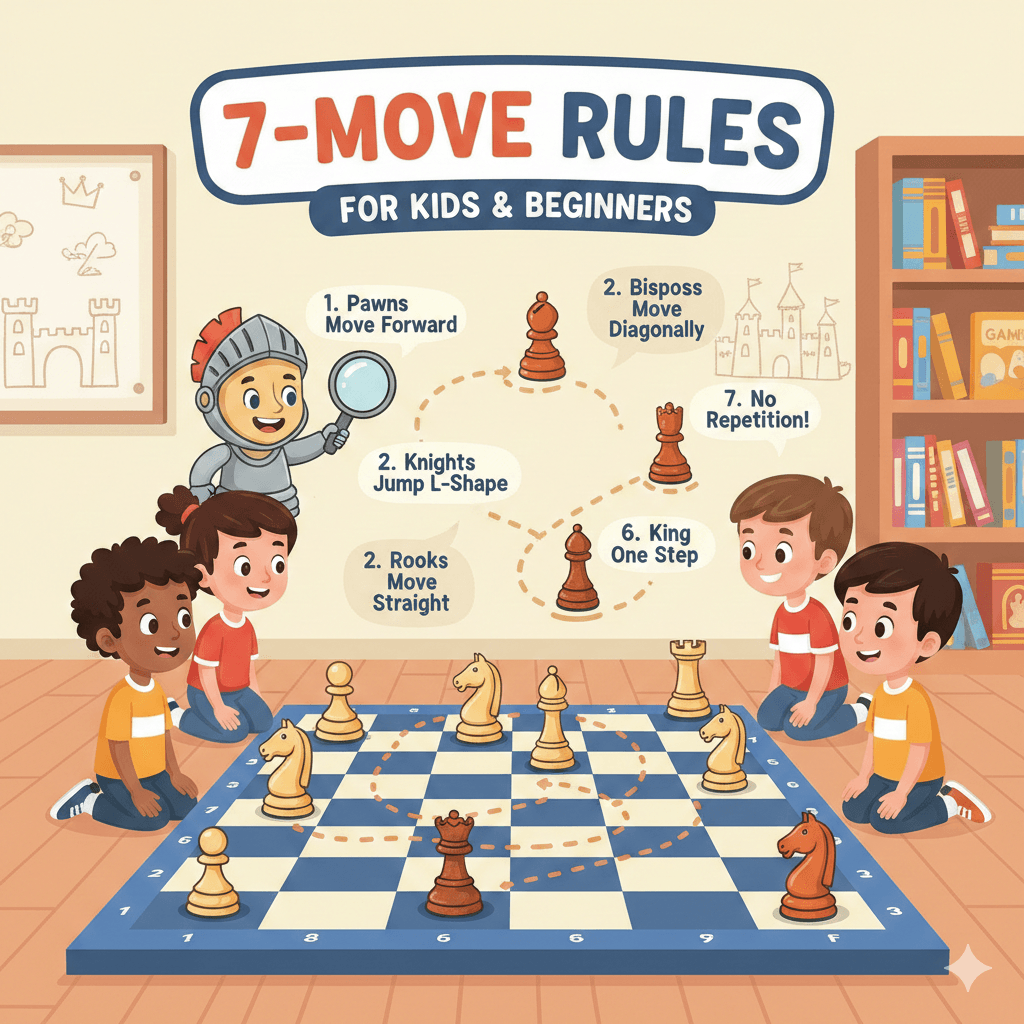
Chess is a completely fun and smart game. It makes you think and also stay patient. If you are new to chess, you might have heard someone say there’s a 7-move rule. But what does that actually mean? Was there a rule called seven moves in chess? Well in this guide you can learn everything about the 7 Move Rules.
Are there any official 7 Move Rules?
First, let’s clear one thing: in official chess rules there is no official rule called the seven move rule. So if someone tells you that the game automatically ends after 7 moves, that is not true. But don’t worry, the idea of seven moves usually comes from beginner lessons and quick checkmate tricks.
What do people mean by 7 Move Rules?
You might try to win very quickly sometimes in 4-5 or seven moves. These are called quick checkmates. The famous fast checkmate is fool’s mate and scholar’s mate. Even famous players like Magnus Carlsen learned the tricks when they were beginners. But here you need to know that there are no official rules and they are just fast winning strategies.
The idea of move limits in friendly games
Sometimes you might create your own rules as a beginner. For example if no one wins in seven moves start. These are not official chess rules, they are just practice rules to make your game faster and more exciting for beginners. In real tournament games the games can last for 20 moves or even 40 moves. There is no limit of seven moves.
Real important chess rules that you should know
As there are no real 7 Move Rules you need to understand the actual important rules. An official chess game if no pawn moves and no pieces captured for 50 moves the game can be declared or drawn. The rule exists to prevent very long games when nothing happens. This is very different from 7 moves. The 3 fold repetition rule is where a player can claim a draw. Again nothing related to seven moves. In professional tournaments if 75 moves pass without a pawn movement or a capture the game is automatically drawn. This rule is not a part of any regulation.
Why do beginners think 7 moves are very important?
The first few moves in chess are called the opening. When you start learning chess, teachers often say control the center in the first five to seven moves. During the opening you should develop your pieces, control the center and also protect your being. Because the first five to seven moves are very important. You might think that there is a 7 move rule but it’s just guidance not a rule.
So you must know that there is no official 7 move rule in chess; it’s usually a beginner’s misunderstanding or a quick checkmate idea. Chess is deep and a beautiful game. It does not end in seven moves unless someone makes a big mistake. Instead of focusing on fast wins it’s very important for you to focus on good openings, strong middle game ideas and smart end game tricks and most importantly you need to have fun.
 Few Seats Left: Click Here
Finally, though intelligent children may be attracted to chess, practice can definitely sharpen the mind. Gained informally or in online chess classes for kids, the positive aspects of chess as a learning activity include improved thinking, increased concentration, and confidence, making it a potent learning tool for growing minds. Contact the Younger Activity Hub to witness your child’s intelligence grow exponentially. It helps maximize the benefits of chess for kids.