
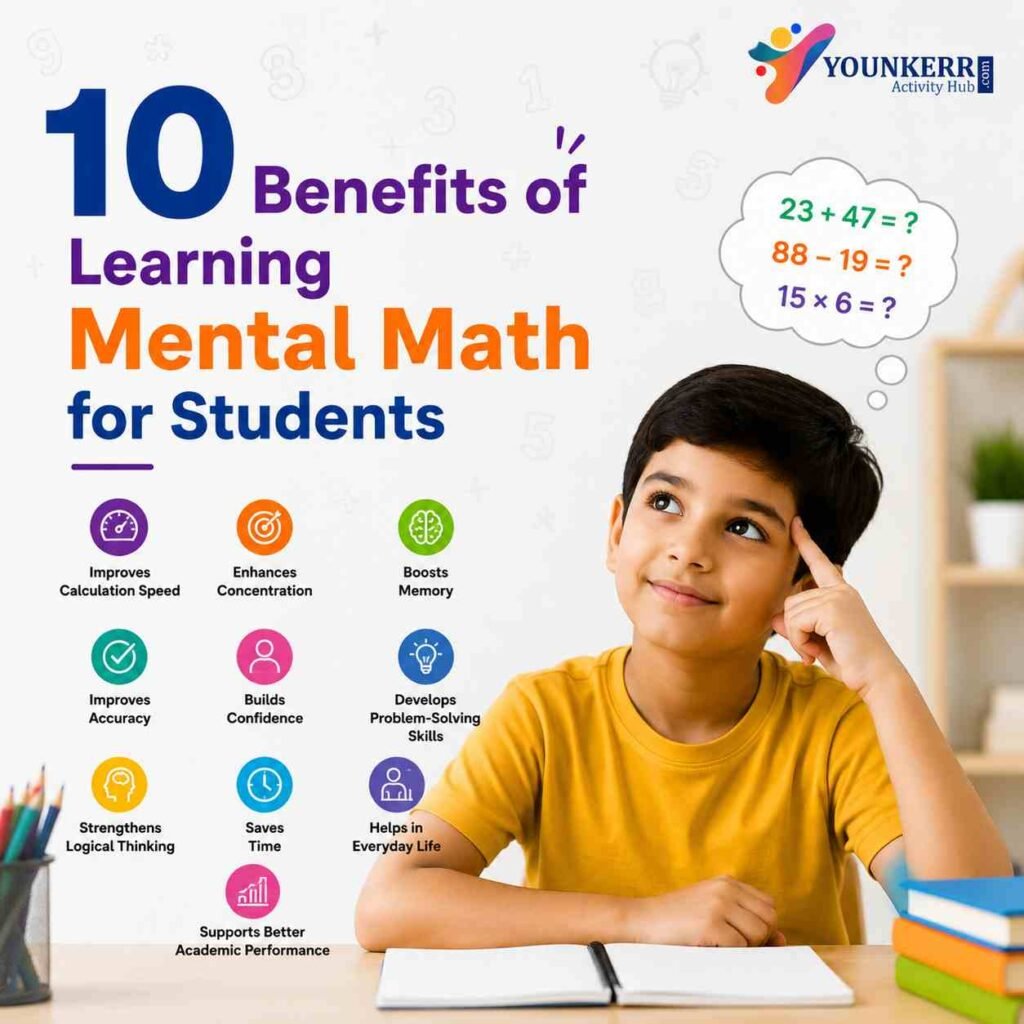
10 Benefits of Learning Mental Math for Students
Math is not just about solving problems on paper or using a calculator. In everyday life, you might need to do quick calculations in your head, whether you are shopping, managing time, or just checking your bill. That’s exactly where mental math is such an important life skill that comes in the picture. Mental math is the ability to solve mathematical problems without using a calculator or any other method, so the good news is that mental math is not about memorizing difficult formulas; it’s all about learning simple techniques.
Improves number sense
One of the biggest benefits of mental health is that it helps you understand numbers better. Instead of simply memorizing answers, you can begin to recognise patterns and even estimate results.
Builds faster calculation skills
Mental math helps you solve problems much more quickly. Simple calculations like addition or subtraction become easier with regular practice. Whether you are answering questions in a class or even completing an exam, faster calculations save valuable time.
Increase confidence in math
You might feel nervous when it comes to mathematics. Mental math helps change that. As you become more comfortable solving problems without relying on calculators to gain confidence in your abilities.
Strengthens problem-solving skills
Mental math encourages you to think instead of simply following steps. Rather than just using one fixed method, you learn different ways to solve the problem. Flexible thinking improves the overall problem-solving ability.
Improves memory and concentration
Solving math problems mentally requires you to remember numbers and perform calculations. This regular mental practice strengthens memory and improves concentration.
Reduces dependence on calculators
Calculators are really useful tools, but you should not rely on them for every calculation. Mental math teaches you to trust your own thinking and solve simple problems independently.
Makes everyday life easier
Mental math is useful far beyond the classroom. You can use it in many everyday activities like calculating discounts, splitting a restaurant bill, measuring ingredients while cooking, or managing pocket money. These practical skills help you become more independent and confident in your daily life.
Prepare students for a competitive exam
Many entrance exams and competitive tests include sections where speed and accuracy are very important. When you are comfortable with mental calculations, you often complete math questions more effectively, giving yourself extra time for difficult problems.
Encourages logical thinking
Mental math is not just about finding the right answer. It teaches you to analyse problems and identify strategies. These logical thinking skills support learning in subjects like science, coding, and engineering.
Makes learning math even more enjoyable
When you can solve problems quickly, math becomes less frustrating and more rewarding. Mental math often includes fun activities and game challenges besides puzzles that keep you engaged. Instead of seeing maths as difficult, you begin to enjoy the challenge of finding faster and smarter solutions.
So, in short, you can say that learning mental math is way more than just answering questions quickly. It helps you build confidence and improve concentration.
Also Read : 7 Reasons why Coding is Important for Young Minds